


It is the paradoxical season of summer, those times when your skin is dry and oily simultaneously.
In case you automatically avoid applying any oil, thinking that it will make the situation only worse, the non-comedogenic oils emerge as unexpected saviors.
In contrast to what everybody usually believes, you can balance your skin, reduce skin inflammations, and avoid breakouts with the help of the correct facial oil in hot weather. The key? Picking oils that cannot clog your pores.
That is where the term non-comedogenic will be your saving grace.
This two-part guide will tell you everything you need to know when it comes to finding the perfect oil to use on your skin in the summertime: one that hydrates and does not suffocate, repairs the skin without a breakout, and nourishes without shining.
What Does “Non-Comedogenic” Really Mean?
What do we decipher about the buzzword? The descriptive label comedogenic is used to define the probability of a substance blocking pores and leading to the appearance of comedones, black and white.
The use of non-comedogenic oils is very particular since they do not block pores.
The comedogenic rating scale exists even among formulators of skin care products and dermatologists. It goes between 0 and 5:
1: No clogging of pores
2: The low probability
3: Moderate
4: It is probably pore-clogging
But this is not a blanket case. Reactions on the skin are different in different individuals.
Light or medium-weight oil rated at two can be a miracle in the skin of one individual and generate pimples in another individual, depending on the kind of skin, the environment, and its application.
This is why it is essential to know your skin and do a patch test on new oils.
Summer Skin Woes: Why Oils Still Matter
During a busy summer day, you could easily be tempted to think your skin produces excess oil more than it can ever need.
However, the thing is that the oil that your skin produces on its own (also called sebum) is not necessarily equivalent to the skin being hydrated or kept in good balance.
Excessive production of sebum may act as compensation for dehydration by your skin. And depriving your skin of oil-based hydration can only encourage your body to get into overdrive and ramp up oil production.
The proper type of oil can:
-
Assist in controlling too much sebum
-
Replenish hydration in a non-weighted fashion
-
Calm skin that is really tanned or swollen
-
Solidify the skin protective barrier that is under attack against UV rays and pollution
Therefore,it is not the oil that is the matter, but the oil that you are using.
Matching Oils to Skin Types (Especially in Summer)
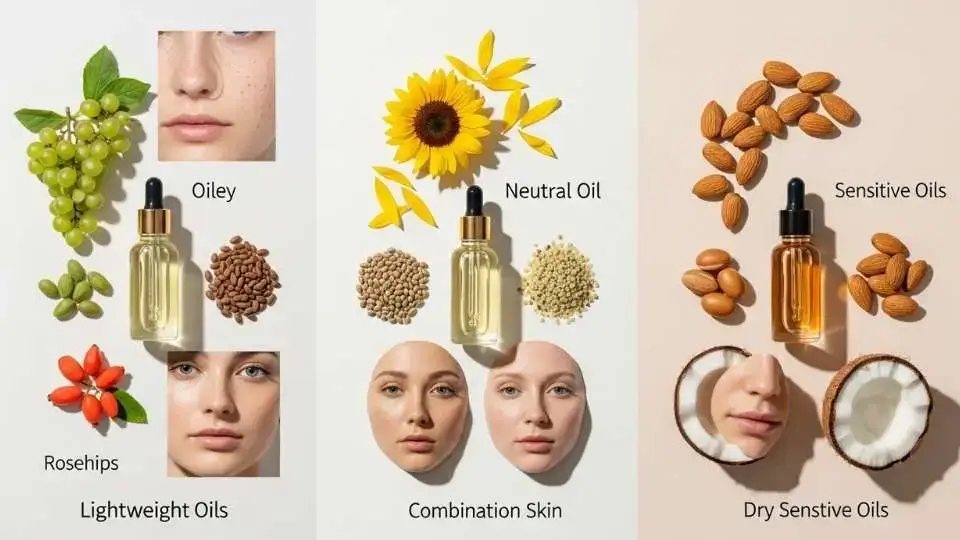
Not every non-comedogenic oil is considered to be the same. Others work better on acne-prone skin, and others moisturize dry or aged skin without causing breakouts.
This is how summer skin type will help you make a decision on oil selection.
1. Oily or Acne-Prone Skin
The oiliness is also exaggerated in summer, and those who break out anyway develop even more skin blemishes.
However, using the correct oil, especially the ones with high levels of linoleic acid, can diminish acne and manage sebum secretions. Light-fast-absorbing oils with a comedogenic scale of 0-1 are your best friends.
The best of the best: Grapeseed oil, Jojoba oil, Rosehip oil, Safflower oil.
2. Combination or Normal Skin
To some extent, during summer, combination skin tends to become oilier in the T zone, and on the cheeks, they may become dry. You will need to find something that will strike a balance between two areas without overdoing it on both sides of the spectrum.
Best to Try: Argan, sunflower, hemp seed oils.
3. Dry or Sensitive Skin
Your skin will not be wet even though you have been sweating like crazy. Dry skin does not only lack water but also other possible lipids. These can be refilled with oils without the heavy feel that can cocoon and smother as in the case of heavy creams in summer.
The best: sweet almond oil, argan oil, and fractionated coconut oil (yes, people, the fractionated type is so much less clogging than regular coconut oil).
Comedogenic Ratings Aren’t Everything—Consistency Matters Too
Important in addition to the number in the comedogenic scale is texture.
Extremely heavy oils, such as avocado or wheat germ, might not even be good summertime skin oils, even if they are not very comedogenic on you personally.
The aim is to seek oils that would have a feathery feel with the ability to disappear into the skin and not have a tacky finish.
Here’s a general rule:
-
Lighter oils (grapeseed, jojoba, rosehip): They are suitable during summertime on oily skin and acne-prone skin.
-
Medium oils (argan, almond): Suitable on the majority of skin types as long as in the drier climates.
-
Heavier oils (castor, cocoa butter): to be used sparingly during the summer or not at all.
The 6 Most Loved Non-Comedogenic Oils for Summer Skin
There are the most advisable non-comedogenic oils that keep on appearing all over the professional blogs and dermatologist’s recommendations:
1. Jojoba Oil
Jojoba is, technically speaking, a liquid wax that replicates the sebum your skin produces naturally. This is why it is suitable for balancing oil production. It is fast-absorbed, possesses anti-inflammatory effects, and can be applied during the daytime or at night.
2. Argan Oil
Argan oil is a lightweight multitasker as it is rich in vitamin E and fatty acids. It moisturizes, combats inflammation, and aids in reviving elasticity, which is why it is a terrific component of dry and mature skin in hot weather. Best Suited To: Dry skin and normal skin, sensitive skin type.
3. Grapeseed Oil
This tightening oil has a light and satin finish and is rich in antioxidants such as polyphenols and vitamin C. It is a natural product that matches oily skin due to its concentration of linoleic acids. Best Suited To: Oily skin, combination skin, or acne-prone skin.
4. Rosehip Oil
Rosehip oil is high in essential fatty acids and natural retinoids, stimulating cell turnover and clarifying dull skin. It also does wonders in healing hyperpigmentation or acne scars. Best Suited: Combination, aging or acne scarred skin.
5. Safflower Oil
Safflower oil is very popular among acne sufferers and is very high in linoleic acid, making it non-irritating. It is cheap, quite common , and mixes with other oils. Best suit: Oily skin and easy breakout in hot and humid weather.
6. Sunflower Oil
Sunflower seed oil is light, smooth, non-greasy, and also stool, so it suits almost all types of skin. It contains a lot of vitamin E and does not feel heavy. Best Suited: suits all skins, especially sensitive or inflamed skin.
Tips for Selecting the Right Oil for You
There are just too many of those so-called non-comedogenic oils to choose which one to select. These are some of the clever standards to be remembered:
1. Check the Comedogenic Rating
Mostly, the ranges below 2—a little of anything tends to be safe for most individuals, except that you should keep track of your skin or your reaction to it.
2. Read the Ingredient List
Healthful is pure oils of a single ingredient. When using oils, avoid blending oils with artificial fragrances, along with dyes or fillers that you are not familiar with, particularly when it is hot outside and your skin is more sensitive.
3. Cold-Pressed and Organic
Cold-pressed oils have an increased number of nutrients. The organic labels also translate to less application of pesticides on your body.
4. Do a Patch Test
Put some drops of the oil behind your ear or in your jaw and wait 24-48 hours. It is very important when your skin is sensitive and/or prone to reactions.
How to Use Oils in Your Summer Routine
There is one thing about using the right oil. It is the ability to know how to apply it in your regular life that will guarantee success in the long run.
-
Apply it last at night as a sealant on serum moisturizer or light treatments.
-
During the morning, use sparingly: combine 2-3 drops with your gel moisturizer or use it underneath your sunscreen.
-
Do not overload: A little will do. Too much is not good, particularly during summer.
-
Give the OCM (Oil Cleansing Method) a go: Provided you have the guts and pig-out-prone skin, oil works on some level as a cleanser as well and can be non-comedogenic at the same time.
When Simplicity Meets Strategy: How to Use Oils the Smart Way
Having learned which oils do not clog your pores, it is now time you know how to incorporate them into your summer Skincare regimen without melting your face and turning it into a frying pan.
Oils are potent when used in the right way, though they require some touch. So, let us start with what most people often misunderstand, that is, how much and when to apply oil.
Layering Oils into Your Daily Skincare

You may already be implementing a hyaluronic acid serum or a water-based gel moisturiser. These are not to be replaced by Oils, but Oils can enhance them.
Morning Routine
-
Wash off your face.
-
Use a moisturizing serum or gel-type moisturiser.
-
Put 1-2 drops of oil of your choice (jojoba, argan, or grapeseed) and lightly push into wet skin.
-
Be done with sunscreen. Always. Your SPF won’t be substituted with a good oil.
Night Routine
-
Make sure to double-cleanse, in case you use sunscreen or makeup.
-
Use any treatment serums (examples: vac, niacinamide, or salicylic acid).
-
Then apply 2-3 drops of oil and seal everything overnight to get luminous skin.
The principle of this oil at the end of the process is that oils are occlusive, which means that they don’t clog your skin, provided that you’ve selected a non-comedogenic oil.
The Oil Cleansing Method (OCM): A Gentle Deep Clean
Using those non-comedogenic oils as a cleansing oil is, indeed, one of those underrated summer things you can do, even when you are oily or even acne-prone.
Here’s how it works:
-
Apply a quarter-sized dose of oil (safflower or sunflower) to already dry skin.
-
It dissolves dirt, sunscreen, and oily sebum.
-
Clean up with a wet, warm washcloth.
-
A mild, water-based cleanser may then be used after that.
The technique not only cleans but also cleans without removing your natural shield- something you must do in dehydrating hot weather.
The Role of Essential Oils: Handle with Care
Although some prefer to drop a few drops of the essential oils into their blends during summer, one should take caution.
Safe Essential Oils for Summer Use:
-
Lavender- sedative, antibacterial
-
Tea tree – acne killer
-
Chamomile- anti-inflammatory
-
Geranium-Regulates sebum
Avoid during the Daytime Use:
Citrus oils (e.g., lemon or bergamot) – make the skin more sensitive to UV and may bring about phototoxic reactions.
Never use essential oils straight on the skin or without blending in a carrier such as a plant oil: always dilute correctly (1-2 per cent = approximately 1-2 drops per teaspoon of carrier oil).
Storage and Maintenance: Clean up your Oils
The oils are natural substances that are sensitive to heat, light, and air. When the summer sun hits late in the year, you will be happy to treat them right to accelerate their shelf life.
- Keep cool and dark cabinets-never store oils in your bathroom or around your windows.
- Keep the lid well sealed to avoid oxidation.
- Think of the storage of precious oils such as rosehip or hemp seed by refrigeration.
- To increase freshness and even antioxidant levels, add vitamin E oil
The oil should be smelled after every few weeks. It also gives a sour odor, which shows it is time to get rid of it.
My Opinion
The idea that you need to have your skin bare during summer is an old idea. Intelligently selected, non-comedogenic oils will serve as a shield, a tonic, a sense of balance, which amounts to protection, nourishment, and balance, without adding to that much-maligned midafternoon shine or acne disaster.
Oil is not fighting your skin. It is struggling against the type of oil it should not fight. Jojoba, safflower, grapeseed, and rosehip can help your skin maintain a healthy glow even on the worst days when there is no escape from the heat.