


Matching suitable shoes to your appearance is not supposed to seem like solving some sort of secret fashion riddle.
However, to play it all straight, most of us have stood in front of a closet that is bursting with clothes and still had nothing to wear—simply because there were so many different kinds of shoes that would (and would not) look right.
Wearing shoe colours that match your clothes may either straighten up your outfit or totally disrupt it. That is where this guide rolls in.
Let us keep it simple. Neither a huge shoe wardrobe nor a degree in color theory can help you pull off stylish looks every day.
By considering a few stabilizing rules, some favorite pairings, and keeping in mind how to combine things with your wardrobe, you can soon become a pairing expert—just like a stylist.
Why Shoe Color Matching Is Important
Let us know why color matching of shoes is even important before going into the mechanics.
Footwear is the base factor of any ensemble. They pull the eyes downward and may either be in harmony with your entire image or be irritatingly out of place.
When your get-up is sleek, tailored, and sophisticated—but your shoes are yelling 80s—the whole effect is compromised. Likewise, a plain outfit can gain instant purpose with the right pair of shoes.
Consider shoes like punctuation. They can underline a statement—or cause your entire message to get lost.
That is why there’s nothing arbitrary about getting shoe color combinations right: you need to know what you’re trying to communicate through your dress.
Color Harmony: The Quiet Key
When it comes to understanding color harmony, realize that this is the balance that makes a clothing palette visually appealing.
You don’t need to memorize a color wheel. A few simple principles can take you far when selecting the right shoes to match your outfit.
Warm Tones and Cool Tones
-
Warm tones include camel, rust, olive, mustard, and coral.
-
Cool tones appear in blue, green, violet, and most greys.
When in doubt, it’s usually safe to match warm with warm and cool with cool.
Opposition vs. Mixing
Opposition catches the eye. If you’re dressed in all neutrals and choose red shoes, then you’re making a statement—on purpose.
Mixing, on the other hand, is milder and more harmonious. Beige dress heels can lengthen the legs, and black shoes with a black suit can make the whole look sleek and seamless.
When choosing between them, ask yourself:
Do you want your shoes to be outstanding, or to become something unnoticeable?
Neutral Shoe Colours That Go with Everything
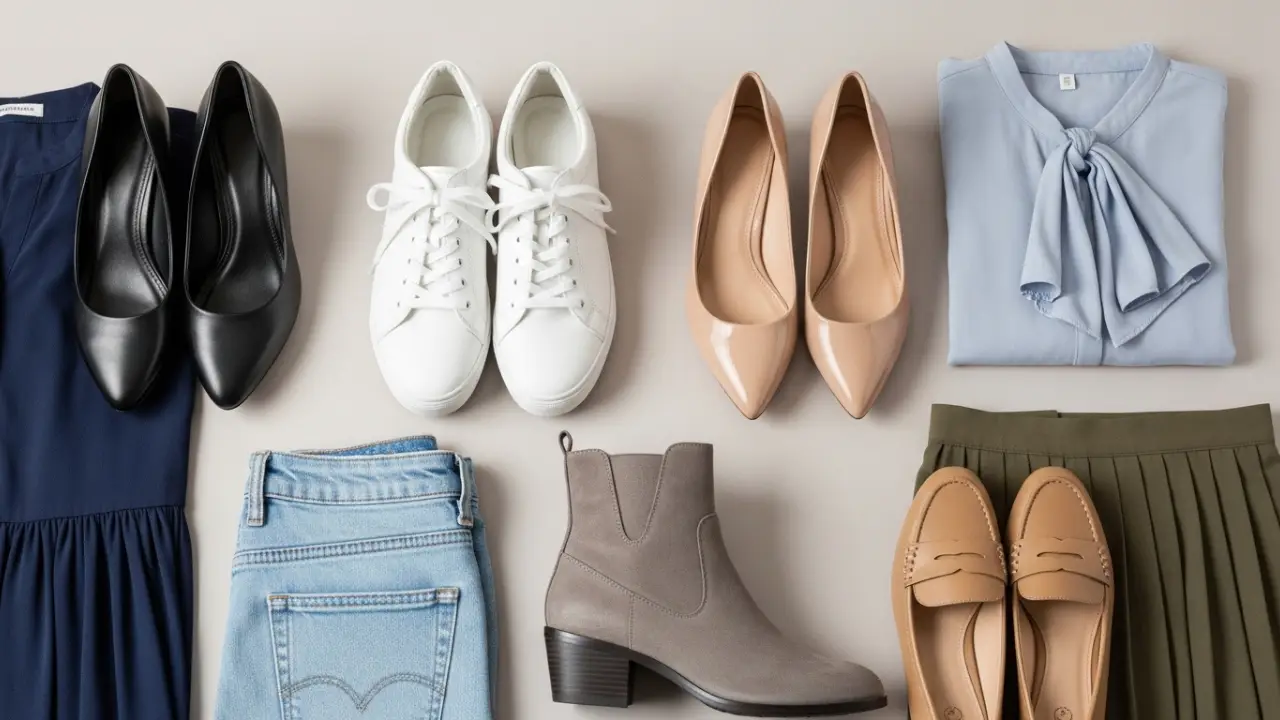
By neutral, I do not mean dull—I mean adaptable. These are colors of shoes that will perform throughout seasons, occasions, and the kinds of outfits.
Black
That is the little black shoe in the shoe world. Black shoe is formal, slimming, and in fashion all the time. They complement better with darker or one-tone outfits—black clothes, dark jeans, jewel-colored dresses. But black may be too much sometimes when it comes to pastels or summer whites.
White
Fresh and up to date, white footwear is enjoying a fashion revival. They do magic with either light or bright attires and create a clean contrast to denim, beige, and even black. Just remember about weather—they do not conceal very well.
Beige / Nude
There are few dinners which are more adaptable. When close to your own skin tone, nude or beige shoes will make your legs look longer, and they will match with a lot of outfits. They come in handy whenever you wish your dress or outfit speaks of itself.
Gray
Gray is a silent force and a convenient scenery to have a seat between black and white. It combines pastels, navies, greens, and even lighter colors. Suede gray in particular is more applicable in the cold seasons.
Brown / Tan
It is perfect as casual/smart casual clothing. Tan loafers, chocolate boots, and caramel-colored flats look great in denim, navy, olive, and earthen-colored attires. Then simply do not match brown shoes with black suits unless those are styled purposely.
In case of uncertainty, it is a fantastic idea to err on the side of neutrals, and look polished.
Wearing Shoes to Other Colors of the Outfits
Since you have your neutral base, we will now see how shoes combine with different shades of clothes.
3 All-black Ensembles
When everything is in black, it is your choice whether you would like to stand out with your footwear or remain stylish. The shoes are black at the most, and elongated and polished, and fun colors can be added through red, metallics, or animal prints. Simply make sure that the shoe suits the tone of the outfit: stiletto heels in the evenings, bulky boots during street-outfits, etc.
White / Light-Neutral Clothing
The ideal contrast can be found on white, cream, beige, or pastel attires. Colored bold shoes such as cobalt, emerald, or blush pink are very pretty. The reason is that you can also keep the same tone space with nude or tan-colored shoes to create a soft, heavenly appearance.
Dark Blue and Navy Blue
Whatever color of shoes you choose, almost every color blends with denim; however, certain ones sparkle more than the others. Safe bets include tan and white in casual attires. Navy outfits match with the brown, burgundy, metallic, or nude shoe. Never combine navy with harsh black unless the rest of the outfit fills the divide with the pattern or the texture.
Strong Colors (Red, Green and Others)
Wearing red dress with a red shoe? Use nude, gold, or gentle metallics. Red on red looks good but it might be tricky except with the very tone. Green? Neutral-coloured footwear or leaning towards brown or mustard. The trick is to allow either feature to stand out—the shoes or the clothing.
Pastels
Tender colors such as light blue, pink, or lilac should be combined with shoes in white, nude, taupe, or light gray. Heavy, dark colors of shoes should be avoided because they create a shock. Consider ballet flats, espadrilles, or simple sandals to make the appearance balanced.
Trends and Textures
In case the prints on your clothing are already bold, such as a floral print, striped print, or plaid print, go ahead and keep your shoes in the background. Go with solids that draw on the print itself. Take the example of a yellow flowery dress with green leaves? The outfit will be brought down to earth with olive or nude sandals.
To Match the Seasons – Hints
Choose shoes that reflect the change of weather—or rather, change in fabric, shape, and even color.
Spring / Summer
-
Consider using lighter shades: white, nude, blush, and light gray.
-
Fabrics such as canvas, raffia, and/or soft leather are seasonal.
-
Experiment with colors: turquoise flats, coral wedges, and lemon-yellow slides.
-
Metallics also work well here, in particular gold or rose gold sandals.
Winter / Fall
-
Use richer colors: burgundy, charcoal, forest green, cognac.
-
Suede and leather are awesome in terms of texture.
-
It is all about boots at the moment—wear ankle boots with your jeans, or tall boots to midi skirts.
-
Even the consistency of pattern can enliven asymmetry of a neutral outfit, such as plaid booties in an otherwise plain outfit.
Seasons matching will also make your outfits feel new and deliberate, even when you get your jeans simply by the closest pair at hand.
Occasion Shoes Matching
Depending on the occasion, you need to wear a different pair of shoes, and the color makes your outfit look very formal or casual.
Casual Days
White, beige, or dull sneakers are all wardrobe essentials. They also wear with jeans, joggers, summer dresses, and even with casual suits. Carefree color-wise here as well—go bucket style, pastel trainers, or patterned slip-ons!
Workwear
Use the traditional shades such as black, navy, taupe, or tan. Loafers, smart ankle boots, or closed-in pumps have to be clean and professional. You can add a splash of color (such as burgundy or mustard) when everything else in your outfit remains toned down.
Evenings & Formal Affairs
This is the place where statement shoes can come out. A dress can be enhanced by wearing red stilettos, or gold slippers, or jewelled heels. During black-tie events, metallics and dark satins will never go wrong. Ensure that the color of your shoe resonates with an accessory or a shade of makeup so that you can pull it together.
Events and Weddings
Nude and silver are universal depending on your outfit. They do not take the attention away from fancy materials such as chiffon or satin. It is best to use soft colors when it comes to events during the day. In evening receptions, you might as well add some sparkle or darker jewel colors.
Matching Shoe and Accessories
Matching your shoes and accessories is one of the greatest styling tricks that is least utilized—even though it is one of the most effective. However, this does not suggest that all should be matchy-matchy; no one wants to resemble a mannequin in color-coordinated outfits.
Should You Match Your Shoes with Your Bag?
Traditionally, yes. Yet 2025? Not necessarily. The contemporary rule is: they have to supplement each other, not copy.
A tan tote and ankle boot? Perfect.
Red clutch and hot pink stiletto? Daring (providing the rest of what you are wearing remains clean).
When your outfit is heavy in texture or print, keep your shoes and bags simple—yet matching in tone (warm or cool). In case you have a solid outfit with one color (such as an all-white outfit), you may apply statement shoes and a bag in contrasting but harmonized colors.
Shoes and Jewellery
This is usually not considered, and yet shoes and jewelry must tell the same language of fashion.
-
Metallic sandals are awesome in pairing with gold or silver jewelry—especially during the evenings.
-
Brown blocky triangle-style boots are best suited with bold statement necklaces or bangles.
-
Nude and slim-heeled shoes are best topped up with thin and delicate chains or studs.
In case your jewelry is colorful, attempt mirroring one of the shades using your shoe—a single one only. It is a very elegant method of tying up the appearance together without shouting at all.
Belts, Scarves, and Hats
Such accents are good for coordinating shoes.
-
A leopard skin belt? Make the style more earthbound with a pair of tan or black footwear.
-
A scarf in pastel? Look at pale gray or nude shoes.
When you start working with a totally new outfit, choose a single accessory as a foundation, and then coordinate your shoes to it to create a perfect rhythm with zero effort.
The Essential Color Matching Mistakes to Avoid
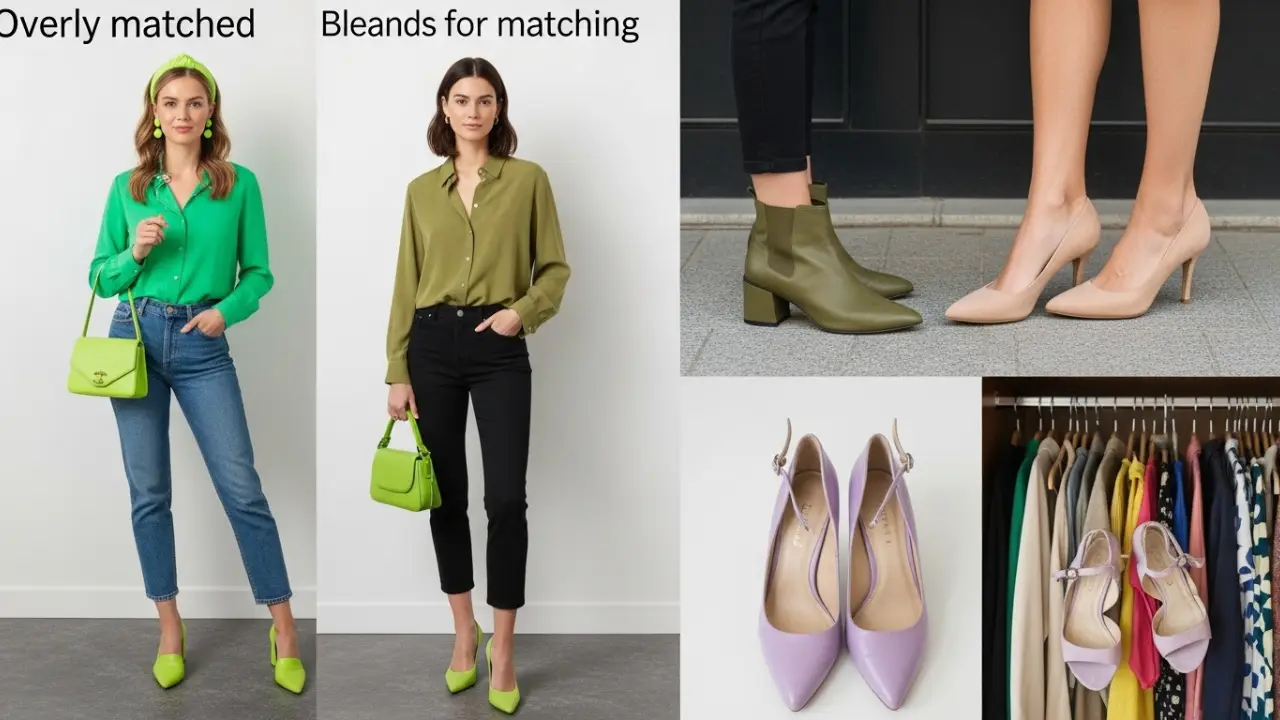
And so, it is time to burst some style myths and prevent making a fashion mistake—even professional dressers can get confused with.
1. Over-Matching All
You may think it is safe to wear: a pair of shoes, a bag, earrings, and a headband all of the same color—however, it turns out forced or even looks like it is out of mode. Rather, work with tones that do not match but do not have to be so similar as to be identical.
To give an example: when you are wearing a blouse in green, then it is more appropriate that you wear an olive shoe than a neon green shoe. Not everything gets previewed with matching—things get previewed with blending, and it is mostly smarter.
2. Rejection of Skin Tone in Nude Choices of Shoes
Nude shoes are not quite made the same. What appears nude to one may appear too pink, gray, or yellow on another one. Wear nude shoes which match your own skin undertones at best, so that they really blend with the legs instead of drawing them shorter. Remember—this is what you will be standing on. It has to fit.
3. Allowing the Colors of Shoes to Be Trendy
You might be enticed to lay out and purchase a pair of green or lavender shoes in the seasonal hype, but it works only when 80 percent of what you own will match the color. Those shoes will then remain in the wardrobe with no use.
When you are playing the color trend, do not forget that there is a need to have a wardrobe to justify the choice of the color—with at least two or three items.
Fad is out, curb-side compatibility style is in.
The Creation of a Capsule Shoe Wardrobe
The easiest trick to never doubt whether your shoes match is to start putting together a capsule shoe wardrobe—a few, but strong and flexible pairs of shoes that match with the majority of the clothes in your wardrobe.
The Basic Colors of Women’s Shoes
-
Black flat shoes or pumps (formal and work)
-
White or near-white sneakers (for casual looks)
-
Beige / nude sandals or heels (especially for light outfits)
-
Brown / tan boots or loafers (perfect for fall and casual chic)
-
Metal shoes (metallic tones like gold or silver, used for events and evening dresses)
Crucial Shoe Colors for Men
-
Derbies or black oxfords (respectable and formal suits)
-
Brogues or loafers in brown (business casual)
-
White sneakers (for off-duty days)
-
Tan shoes or chukkas (ideal for in-between seasons)
-
Gray or navy trainers (for silenced sporting apparel)
Keeping them in rotation makes planning your outfits quite easy. You will waste less time doubting—and more time walking in confidence.
Intellectual Showbiz Hacks
You do not have to bring the new order to your wardrobe every day. These are some of the tips on how to make shoe–outfit coordination easier in the real world:
Apply the Anchor Piece Rule
Choose one outstanding piece of clothing—your jacket, blouse, or shoes—and construct around it. When you choose a focus object (your shoes, say, red heels), choose other clothing items with at least one matching or neutral color that can accentuate them.
Think in Color Capsules
Don’t think of the things in your wardrobe as separate items, but in families.
As an example: having a closet dominated by navy, white, and olive shades? Tan or grey shoes will open an unlimited amount of matching possibilities.
Shoes should be purchased according to the palette you already have—not impulsively.
Outfit Photos
Write down on your phone a personal style board of successful outfits and shoe combinations. Scroll and repeat on rushed mornings.
After some time, patterns of the colors that you tend to reach for most—and what you lack—will become obvious.
Technology is to be used in moderation.
Fashion apps allow you to post your clothes and make virtual outfit combinations. They are not one hundred percent correct, but they are amazing to test color ideas of shoes without trying everything on.
Colour Matching Different Personal Styles of Shoes
Do you want to be minimal and classic? Frivolous and audacious?
Shoe matching does not only concern coordination—it is also a manner of expressing your own style.
For Minimalists
Keep them to blacks, nudes, whites, and soft grays. These colors help to accentuate clean silhouettes and give way to tailoring.
The sample amount of shoes in a minimalist wardrobe may amount to no more than 3–4 pairs, which can be used in rotation.
For Maximalists
Experiment with print, metallics, bold colors, and adorned shoes.
That is just to ensure that every wild pair of shoes can be associated with something in your outfit—be it a belt, shade of lipstick, or even nail color.
Planned disorder continues to require order.
Classic Dressers Prefer to 45…
Make it with timeless colors: black, navy, brown, burgundy.
Pumps, oxfords, and ankle boots are classic shapes and will never disappoint you with such colors.
Find interest in texture—such as suede, polished leather, or even crocodile print—without going off theme.
Style of Men: Using Shoes and Attires
And we cannot forget the guys. The everything-black-shoe paradigm does not work anymore in present-day styling. Fashion has gotten more expressive on the part of men—when properly done.
-
Black shoes and suits are combined with black, gray, and navy suits. They are corporate and get down to business.
-
Brown shoes go well with tan, navy, or olive clothes. The lighter browns are used during the day, while the darker ones are used in the evening.
-
White sneakers apply to everything casual and smart-casual—just make sure that they are clean.
-
Tan or burgundy loafers and boat shoes work well with a combination of chinos and button-downs, creating a clean, casual style.
-
Dark suede or leather boots go perfectly with jeans and flannel or outer clothes.
A universal advice? Your belt and shoes do not need to match the same color—but should exist in the same family of colors to have a coherent end product.
My View | It Does Not Matter That One Is Perfect | It Matters Being Confident
It is tempting to think too much when matching the color of shoes with outfits.
The trick is the trick? Become familiar with your closet, wear shades that suit you, and have faith in your vision. Eventually, you will just develop a knack for what works.
Fashion is a combination of science and the art of the individual.
You do not need 50 pairs of shoes—but a few which make sense with what you have.
Make your match-ups purposeful, fluid, and life-influenced, rather than tropical to what is popular on social media.