


The past few years, I have been able to hear almost all fashions advertisements declare that they are now eco, green or natural. I felt the energy, being a person with a style and a concern with the whole planet, to think it would be a breath of fresh air, however, going deeper it was not. The more I searched, the more I understood that numerous of these statements are hollow expressions covering historic fast-fashion strategies. This was my awakening call of sorts: not everything marketed as an eco-friendly garment is indeed environmentally friendly.
Nowadays, the increasing consumer demand of green clothes has made many brands sell as ethical divergent of those areas that have not transformed. This is referred to as green-washing: the act of making misleading statements in an attempt to appear more environmentally friendly than ones actually are. And it is so extensive, particularly in the fashion industry.
This paper will guide you through the steps of identifying green-washing in fashion marketing. You will get to know how to identify vague wordings, verify certifications, ask intelligent questions and not get fooled. Now that we have dispelled the smoke out of these jargons, it is time to make the real shift towards sustainability in the world of fashion.
What Is Green-Washing?
Green-washing occurs when companies dazzle and promote their products as environmental friendly without justifying that with their operations. Consider: recycled polyester tees with zero recycling sign on them, or a so-called organic capsule collection that barely makes 5 percent of the brand output.
This strategy has become widespread to the point where a large number of consumers lost their trust in any claim of sustainability. However, we can reverse that trend—by understanding how to separate good marketing, allowing it to do its job, and the fluff that is simply deceiving.
Green-washing is not only dishonest, it makes the honest ethical brands less trustworthy, devalues and discredits the work of legitimate ethical companies and it allows unethical companies that pollute to continue business as usual at the expense of the planet and those, who work to make our clothes.
The Reason Fashion Is Particularly Vulnerable
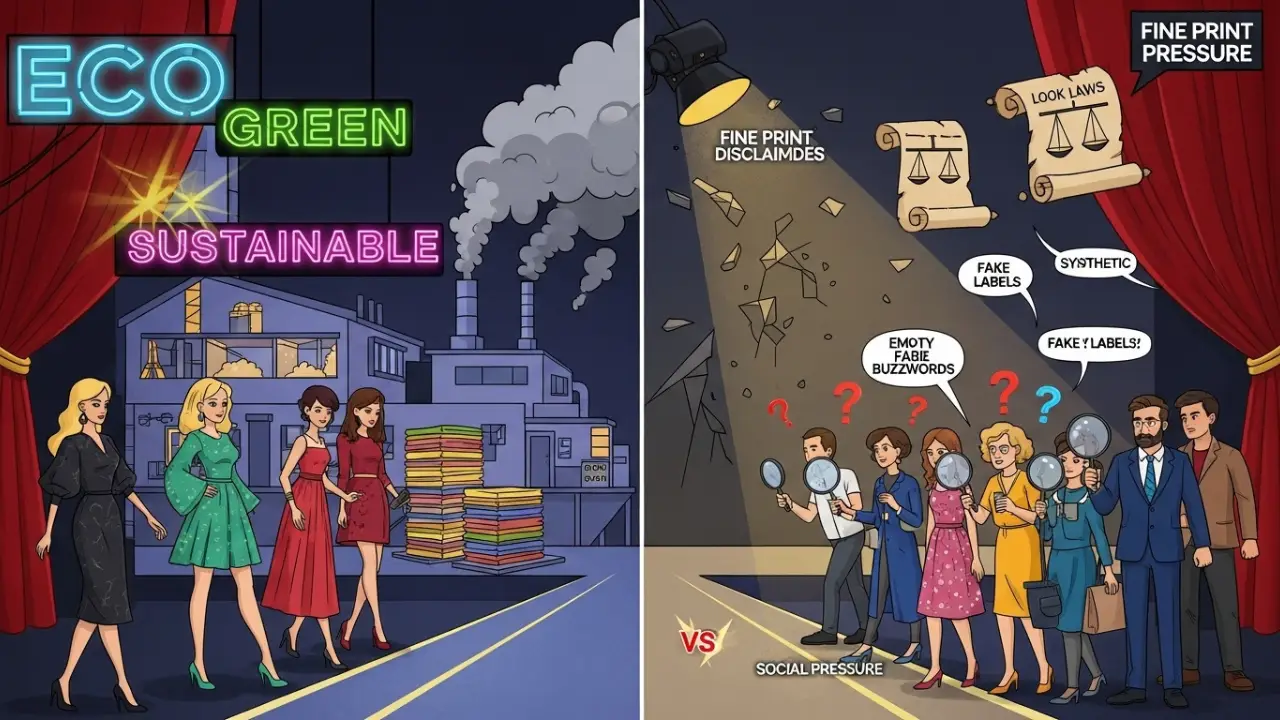
Fashion has always been quick, glitzy and money-minded—its ideal development environment, green-washing. Here’s why:
-
Fast fashion produces low-priced clothing that trades by catching trends fast. The label can give instant value with no real substance to it, preferably in bold green writing.
-
The laws are spotty. In contrast to food labels, fashion credentials have not been standardized and reinforced in most markets.
-
Buzzwords sell. A clause such as natural, eco, or ethical sounds good—when not substantiated however, it is merely a marketing clap-trap.
-
Social pressure. Ethical consumers want to be told the truth. The solution to that demand is marketing by brands, not reform.
And in case you are like me, the fact of paying attention to what sells may cause brands to shift, particularly when we yell green-washing. Our eyes are required in that movement.
Ordinary Green‑Washing Techniques
In order to be not fooled, you should be aware of these tricks:
1. Ambiguous Use of Words
Such words as eco-friendly, natural, or pure become meaningless when they lack details.
Question: What is it actually that makes it eco-friendly? Are they numbers or certificates?
2. Token Collections (Green)
This is whereby a brand introduces a small-scale sustainable line, leaving the rest of operations as was.
3. False Badges and Logos
Certain brands print their own so-called certificates in form of leaf graphics—but they do not uphold it with acceptable standards. Devoid of support, the badges are useless.
4. Too Good to Be True Price
Sustainability does not come cheap. Assume that tees made of organic cotton may cost 5 bucks. Give a reason.
5. Disclaimers to Be Concealed
Big caveat: Usually in tiny print or on the footer of websites, big caveats loom like “viscose is produced sustainably,” with no mention of production practices.
Suppose we see it this way:
| Tactic | What It Looks Like | Why It Misleads You |
|---|---|---|
| Vague terms | “Eco,” “green,” “natural” | Sounds good—but no proof |
| Token collection | “Conscious line” of 1% of products | Green sheen, but 99% is fast fashion |
| Fake badges | Custom logos with no certifier | Creates false credibility |
| Low price with big claims | $5 organic tee claims | Sustainability has real costs |
| Hidden disclaimers | Small print on product page | Misleads with half-truths |
The Need to Differentiate Between Green Marketing and Green-Washing
And not every eco-claim is lying. The idea of true green marketing obviously is transparency, certified practice, and quantifiable objectives.
A fashion brand will write in their description:
“The shirts are manufactured out of 100 percent of GOTS-certified organic cotton, and the sources of that cotton were a certified farm environment in India.”
They will have a logo of certification that will lead to documentation that contains the information on production.
It is the right concept of green marketing.
Certifications and Verification
The paragraph below contains information on the procedures used to verify certifications.
The following are the common certifications which are believed to provide authentic sustainability supervision:
-
GOTS (Global Organic Textile Standard)
Determines the presence of organic fibers and ethical work. -
OEKO-Tex Standard 100
Certifies that garment materials do not have dangerous chemicals attached to them. -
Fair Trade Certified
Refers to fair remunerations and desirable working environments. -
Bluesign
Checks the safer textile process.
The same point can be illustrated by verifying claims by:
-
Looking up the logo on the product or site.
-
Choosing the option of clicking to the official certifier database in order to verify information.
-
It is possible to copy and validate a certification code by searching it.
Real-Life Examples of Green-Washing
I have already seen a number of brands that promote a special blend of sustainable goods, but the rest of their productions is still the traditional and harmful one. For instance:
-
The same factories and dyes might continue to be used in the making of the fast-fashion jeans, but a brand can sell so-called sustainable denim line.
-
One company may have recycled fabric in the marketing, but the other would not take a comment when someone says that most clothes consist of virgin polyester.
Passages such as these persuade me that to go green goes beyond the tagline—rather, it is the process behind the green.
Tips and Tricks | Before You Buy
Sustainable shopping comes with keeping an eye out:
-
Check the small print. Seek details of materials, sources and processing.
-
Ask questions. Write by email to the brand: Where is the cotton cultivated? Which certification?
That is, door close in 48 hours in case they are not able to respond clearly. -
Watch prices. It may also turn into the case where a product has that green label, but it is suspiciously cheap—there is a likelihood of green-washing.
-
Look on independent websites.
Other websites such as Good On You and Remake contain brand audits and ratings.
Instruments to Aid in Checking Brand Statements
It is not necessary to have an expert to perceive through the noise. The following tools may simplify your work:
-
Good On You
A popular site which evaluates fashion companies according to their influence on people, planet, and animals. -
Remake
Provides transparency and ethical sourcing scorecards. -
Certified B Corporation Directory
Directory of certified companies devoted to a high social and environmental impact. -
GOTS Public Database
Allows you to verify whether the brand claims that it is organic are confirmed. -
Fair Trade USA LookUp Tool
See if a product or brandmark really is a Fair Trade product.
In case of a brand making sustainability claims, type its name in these databases. And unless it is listed—or has low rating—there is high probability the brand is green-washing.
Easy rule of thumb I have:
When a brand cannot explain what happens in their process comprehensibly, they have something to hide.
Red Flags To Watch Out For
| Red Flag | Why It’s Suspicious |
|---|---|
| “Sustainable” with no data | Vague terms without evidence mean nothing |
| No factory transparency | Brands that don’t share where or how their clothes are made |
| Unrealistic pricing | Ethical production doesn’t come at rock-bottom costs |
| Small eco lines, huge fast fashion | A token effort that hides a harmful business model |
| Use of trending words only | Brands chasing buzzwords instead of actual progress |
The Brands That Are Doing It Right
To complete the picture of criticism, however, we must highlight several examples of fashion firms practicing authentic sustainability:
-
Patagonia
Transparently posts its supply chain, working conditions as well as environmental objectives. Uses reused material and has the clothes repaired by Worn Wear. -
People Tree
GOTS-certified organic cotton, fair pay, and has always advocated ethical manufacturing. -
Eileen Fisher
Clear in materials used, fair trade collaborations, and circular design using take-back schemes. -
Nudie Jeans
Repairs are free of charge, prices are easy to understand, and most items are made of organic cotton.
Nothing wrong with these brands talking the talk and showing the receipts.
When going shopping, try to support such brands as these ones: offering traceability, certifications, and truthful storytelling.
Brilliant Questions to Ask Before You Purchase
The next time you encounter what the corporation claims to be a sustainable product, ask yourself:
-
Why is this sustainable?
-
What conditions does it work in and where?
-
Does it get certification by a third party?
-
What is the life of this product?
-
How many per cent of your collection goes up to these standards?
When all the brand can tell you is an evasive feel-good copy and nothing to show by way of evidence, that tells you to skip it.
What Is Wrong With Green-Washing?
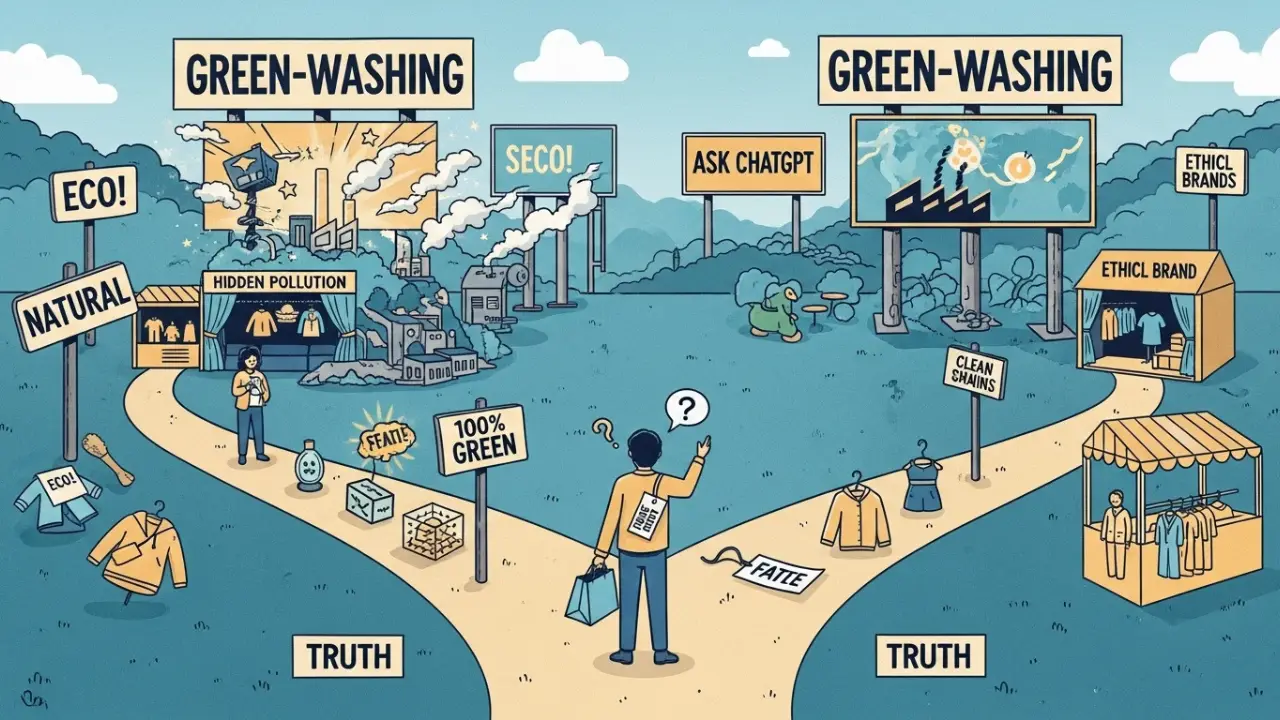
You may want to say, “Well, that is a step in the right direction at least.” However, the result of green-washing is damaging in fact:
-
It disorients and deceives a consumer that is simply trying to do better.
-
It allows dirty businesses to be able to appear clean whilst conducting business as usual.
-
It crowns over smaller authentic ethical brands who cannot compete against phony messages.
-
It delays the change of the system, disallowing fashion to leave exploitation behind.
Honesty and transparency must be rewarded in order to achieve change—instead of glitzy empty labels.
What You Can Do About It
The battle against green-washing does not imply quitting fashion. It entails smarter shopping, and holding brands to a ransom.
This is how you can join the solution:
-
Go out and support the truly ethical brands
Even though it may be less regularly, do it more consciously. -
Call it out
Those who see through misleading marketing should comment, share knowledge, or pose difficult questions. -
Educate and teach
Motivate your friends on what to look out for to avoid fake green claims. -
Give your wardrobe longevity
Pay less, mend more, and share with your friends. -
Show force to better laws
Fight indifference to fashion labeling and certifications.
Your dollars and your vote count. Brands feel this when we push back, and some of them even listen.
Future of Fashion Transparency
The new lies ahead and it will not be constructed by new advertisement campaigns.
It will be influenced by:
-
Transparency tools
-
Accountability to customers
-
Brands that opt to make progress rather than profit
There is new legislation coming round the corner—a Green Claims Directive in the EU—that would potentially penalize brands that lie about being green or having green products. Your consciousness is your best shield up to this time.
Summary
Being a former victim of falling in love with every green-looking label,
I am now seeking facts rather than promises. I worry about where and who makes my clothing—not what marketing advertisement claims.
Sustainable fashion is not ideal.
But green-washing? That is not a shortcut any longer.
Ask yourself questions about every green tag you encounter and reward the brands who are really trying.
Fast fashion does not want to take sustainability behind its back and leave us with even greater waste.
For comprehensive guidance on ensuring transparency and compliance in promoting sustainability-related products, refer to ASIC’s Information Sheet 271: How to avoid greenwashing when offering or promoting sustainability-related products